

Our partners
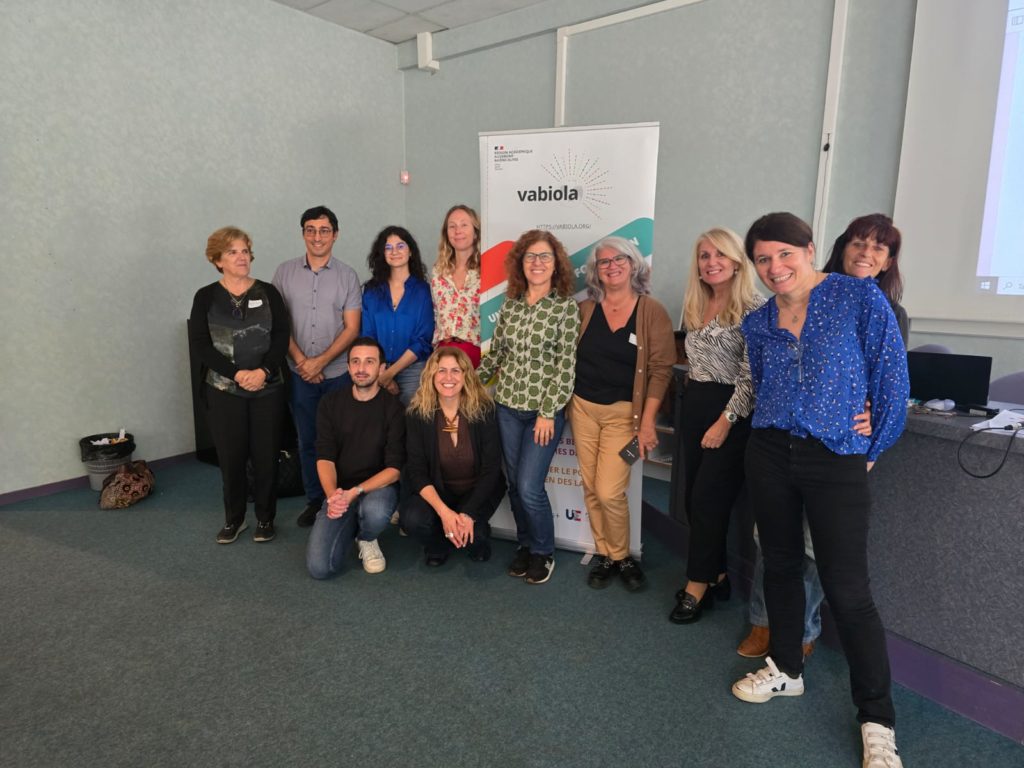
Our multilingualism experts
They make the project possible. Discover the partners who share our values and support us on a daily basis.

Auvergne-Rhône-Alpes academic region
The Auvergne-Rhône-Alpes academic region includes the academies of Lyon, Grenoble and Clermont-Ferrand.
It is one of the largest educational regions in France, covering a diverse territory ranging from large cities to rural and mountain areas. With nearly 1.3 million pupils, apprentices and students, it is distinguished by its economic, scientific and cultural dynamism, and is developing numerous European and international partnerships.
In the framework of the VABIOLA project, the services involved are the Regional Academic Delegation for European, International Relations and Cooperation (DRAREIC), the Academic Centre for the Schooling of Newly Arrived Allophone Students and Children from Itinerant and Traveller Families (CASNAV) and the Academic School of Continuing Education (EAFC).
From one lake to another - Dulala
Created in 2009, the Dulala association supports professionals and parents so that children who grow up with languages other than French can flourish and succeed at school.
In 15 years, the association has trained more than 28,000 professionals on issues of multilingualism and inclusion and has produced numerous resources.
More than 600,000 children have improved their language and French skills.

the Department of French Language and Literature of the Aristotle University of Thessaloniki
The Department of French Language and Literature is one of the two national institutions, the other being part of the academic structures of the University of Athens.
Responsible for the initial training of French-language teachers who will be called upon to teach in the public and private education sectors, or in language training centres, throughout the national territory.
With the aim of training also specialists, capable of supervising private or public sector organizations and strengthening the scientific potential of Greek or foreign educational institutions, the Department also develops master’s and doctoral research programs.
Participating in the Erasmus project to promote language biographies has allowed me to better understand my own linguistic and cultural background, as well as that of my students. I became aware of the richness of all languages and experiences. It gave my students confidence to express themselves in class and share their stories. I like this project because it values each student in his or her uniqueness.

ΕΕPΕΚ - Scientific Association for the Promotion of Educational Innovation
EEPEK (Epistimoniki Enosi gia tin Proothisi tis Ekpaideftikis Kainotomias), i.e. the Scientific Association for the Promotion of Educational Innovation, is a Greek non-profit organisation.
Its mission is to promote innovation in education through a series of events and activities that will support the creation, evaluation and dissemination of innovative educational practices, methodologies and tools within the European Education Area and society as a whole.
EEPEK members are education professionals at all levels, from pre-school to secondary and higher education, adult education and vocational training.
“As a teacher, integrating language biographies into the classroom has profoundly changed my practice. I have seen my students get involved with pride, get to know each other better, and recognize the value of their languages and cultures. This strengthened the cohesion of the group and their motivation to learn. It is a powerful tool for an inclusive and reflective pedagogy.”
National Institute of Teaching and Education, Claude Bernard Lyon 1 University
INSPE is a university institute specialising in the training of teachers and education professionals, integrating both initial and in-service training.
Each year, it welcomes more than 2,500 students on several sites in the Lyon education authority, in partnership with other universities and institutions in the region.
INSPE prepares students for the different courses of the MEEF (Teaching, Education and Training Professions) master’s degree, which allows students to become school teachers, middle school teachers or senior education advisors, and also offers training in training engineering and inclusive education.
In an academic context increasingly marked by internationalisation and linguistic diversity, the development of linguistic and intercultural skills appears to be essential today. Recognizing and valuing students’ home languages makes it possible to transform linguistic diversity into an educational resource. By integrating these languages into the classroom, the teacher promotes inclusion, supports student motivation and contributes to their success by establishing a link between the knowledge of everyday life and that of the school. Thus, Vabiola app is a great tool that helps teachers to recognize, value and mobilize the linguistic richness of their students.

University of Aveiro - Universidade de Aveiro (UA)
The University of Aveiro (UA) is a higher education institution located in Aveiro, Portugal. Founded in 1973, it stands out for its strong focus on research, innovation and the training of highly qualified professionals.
The AU offers a wide range of training in various fields, including science, engineering, social sciences, arts, and humanities.
In addition, it has modern infrastructure, international partnerships and a commitment to sustainable development and the local community.
“The Aveiro team sees the VABIOLA project as a unique opportunity to articulate research and pedagogical practice, promoting new approaches to valuing linguistic and cultural diversity in schools, as well as in teacher training. That’s why everything revolves around this project and the VABIOLA application, which allows us to develop the multilingual skills of our students through the use of digital technology.”
Autonomous Region of Valle d'Aosta
Supervision of Cultural Activities and Assets, the Education System and Intergenerational Relations Policies - Office of Support for School Autonomy
The Office for the Support of School Autonomy operates within the Superintendence of Schools of the Autonomous Region of Valle d’Aosta, a branch of the Assessorate of the education system.
It is responsible for teacher training, European Erasmus+ projects and manages relations with local authorities and associations, and other national, European and international bodies.
Arteveldehogeschool - Artevelde University of Applied Sciences
Higher education institution in Ghent, Belgium
Arteveldehogeschool/Artevelde University of Applied Sciences is a Belgian Dutch-language university established on various campuses in the city of Ghent.
The Artevelde University of Applied Sciences is the result of the merger of four Ghent universities on 31 December 2000. It has grown to become the largest Catholic university in Flanders and the second largest Flemish higher education institution.
The university defines itself as a progressive centre of expertise for education, research and development, where internationalisation is a cross-cutting theme. It trains professionals at level 5 (Associate Degree) and 6 (Bachelor), who demonstrate their talent through creativity, innovative thinking and entrepreneurship, and pursue excellence and sustainability.
The university offers a wide range of training courses, including vocational baccalaureates grouped into centres of expertise (business management, communication management, occupational therapy, graphic and digital media, journalism, speech and language therapy and audiology, office management, podiatry, obstetrics, nursing, social work, applied psychology) and teacher training (childcare workers, primary school teachers, secondary school teachers).
The Artevelde University of Applied Sciences has an extensive network of international contacts and is an active partner in international networks and projects for educational and research purposes.
“The Ghent team sees many opportunities in the VABIOLA project:
- encourage the overall and continuous monitoring of students,
- valuing formal and informal learning,
- offer opportunities for the diversity of school and family cultures,
- complement traditional assessments and certificates with the recognition of multilingual skills,
- encourage students to self-management and self-evaluation,
- facilitate contacts between parents and teachers,
- raise awareness of the challenges of multiculturalism,
- to be a lever for the development of skills in intercultural mediation,
- making education more accessible, sustainable, fun and interactive through a new digital dimension. »